Clash Mini: Cursed Product Design?
May 17, 2023
Recently, Clash Mini has become a hot topic in the gaming world. Anticipation has been building, with Supercell hinting towards a global release of the game. Javier Barnes, an industry-acclaimed Product Manager, recently penned an insightful article via Deconstructor of Fun, dissecting the game’s features and comparing early data against other hits. His prediction? Clash Mini won’t hit the global stage anytime soon.
Arriving at a similar conclusion, I approached the analysis from a slightly different angle: Product Design. In my understanding, Product Design is the strategic alignment between the game genre and its design, with the target player motivations (see Quantic Foundry insights on Gamer Motivations).
Let’s dissect Clash Mini into its basic components to understand the harmony — or lack thereof — between these elements.
- Game Genre: Auto Chess. This genre is characterized as an auto battler, often incorporating chess-like components. Players strategically position characters on a grid-like battlefield during a preparatory phase. These characters subsequently engage with the adversary’s team, all without further player intervention. Despite its initial surge in popularity following the Dota Auto-Chess release in early 2019, the genre has yet to birth a hit mobile title.
- Game Design: Clash Mini adopted the Auto Chess genre and integrated it perfectly with the Clash IP, yet failing to introduce any significant twists to the core gameplay. They’ve created an excellent Auto Chess game.
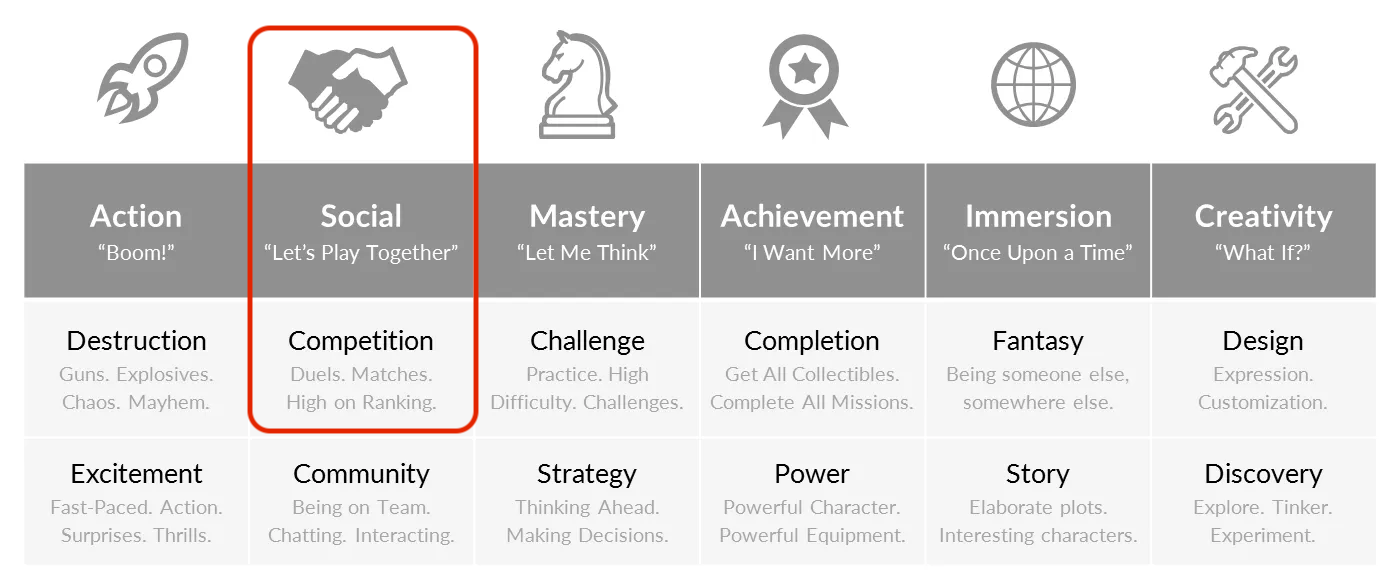
- Target Player Motivations: If there’s one thing Supercell is recognized for, it’s their knack for crafting competitive multiplayer games from simple, ingenious game designs, perfectly tailored to mobile limitations. They’ve earned the trust of midcore players seeking more than casual gaming experiences on mobile, primarily focusing on the Social – Multiplayer component.
Deconstructing Competitive Game Design
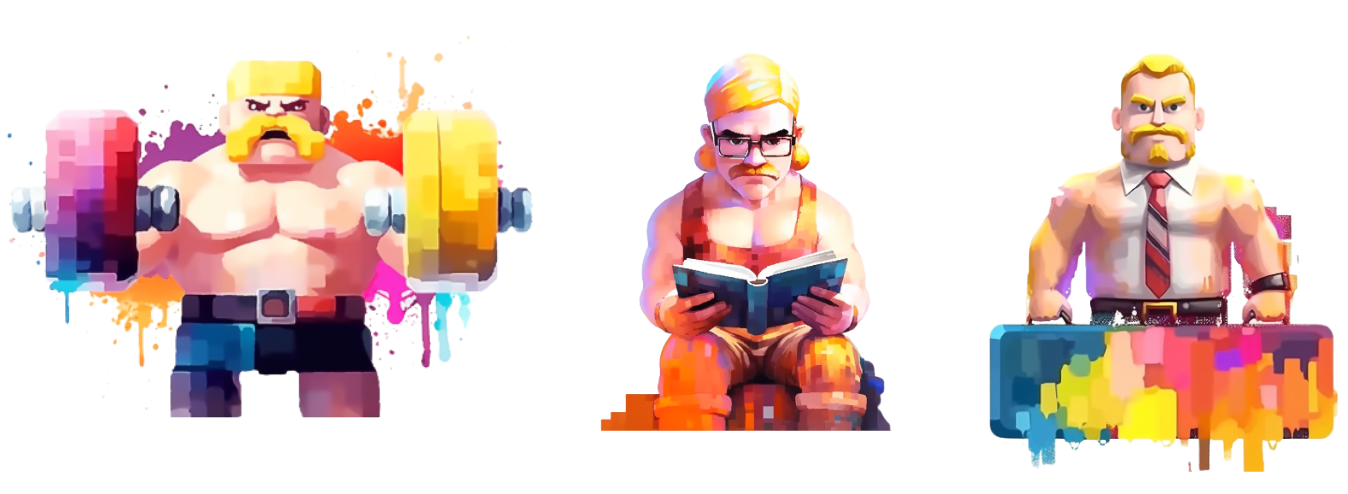
Victory or defeat in any competitive experience hinges on three fundamental components:
- Luck: Random elements inherent to the game.
- Skill: User ability involving dexterity, reaction time, or strategic thinking.
- Stats: Defined as the level or power of your character or team.
Let’s examine three different non-digital competitive scenarios:
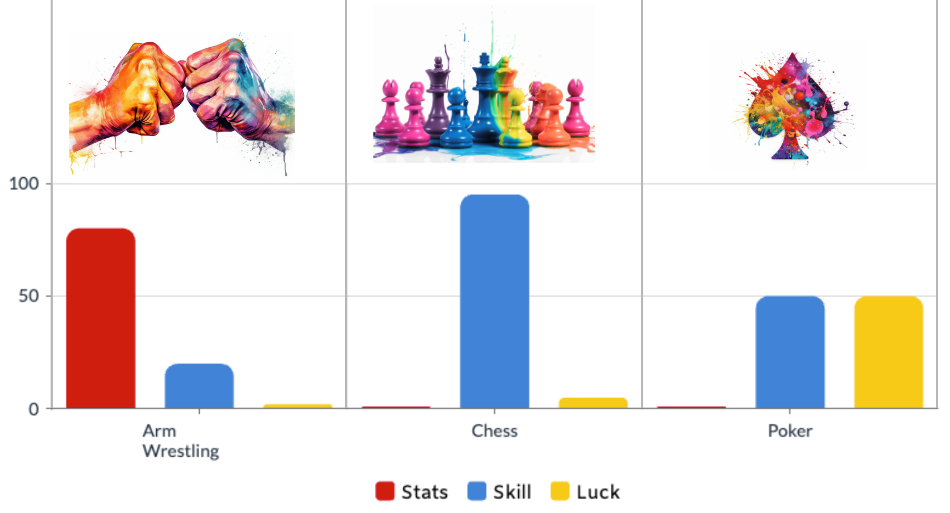
- Arm Wrestling: Stats (physical strength) is the most crucial determinant. Luck plays a negligible role.
- Chess: Both players have equal stats and luck plays a minimal role. Skill emerges as the sole deciding factor.
- Poker: Skill is undeniably important, but it remains a game of chance at its core. Luck accounts for at least 50% of the victory-determining factor.
Similar structures are found in well-known mobile multiplayer titles:
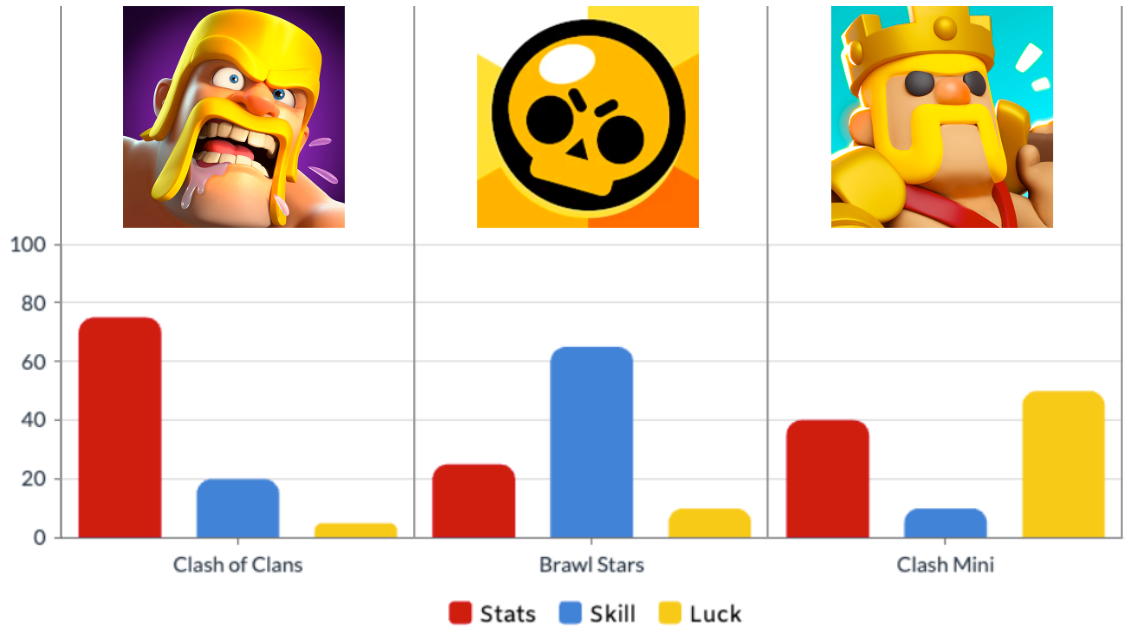
- Clash of Clans: Power overshadows the other factors. Attacking a user one or two levels higher is impractical regardless of skill.
- Brawl Stars: Heavily skill-dependent. The user must control two joysticks simultaneously while managing positioning and character strengths.
- Clash Mini: The most luck-dependent among all Supercell games. Battles play out automatically, the initial unit layout is semi-random, and units available for purchase are also an aleatory sub-selection of the team composition. This makes Luck a prime determinant of victory, followed by Stats, and finally Skill.
Where does the line get drawn?
The first generation of competitive games — Counter-Strike, Starcraft, DOTA — relied entirely on Skill. Power emerged later, particularly in mobile games, as a substitute for Skill, and was surprisingly accepted by mobile gamers. Luck too has its place, as games like Hearthstone and Fortnite demonstrate.
However, no competitive games where Luck dominates completely exist outside of gambling scenarios. You probably can’t imagine a serious tournament of Rock Paper Scissors.
The line, in my view, is drawn when the Luck element prevents players from learning from their losses. In competitive games, players should be able to assess their performance and identify areas for improvement.
Ultimately, the progression in competitive games is the ranking ladder. To progress, players must outperform their competitors at similar levels of stats / skills. A game based purely on Luck does not facilitate this growth, thus potentially leading to frustration among players driven by competitive motivations.
In the case of Clash Mini, it appears this line has been crossed. The auto chess nature of the game confines most decision-making to the spaces between fights. Despite the complexity of board positioning and unit selection, much of the final outcome relies on Luck, and the reasons for failure can often elude even top players.
What’s next for Clash Mini?
Here are two potential paths:
- Adjust the audience. Switch the focus from competitive players to a more casual audience. Many games with a high Luck factor have achieved tremendous success outside of the Competitive category. By transforming the gameplay experience, Clash Mini could become an excellent casualized experience.
- Iterate on the core gameplay significantly to diminish the Luck element. Keep up with its predecessors’ competitive spirit and ensure players aren’t frustrated by the mechanics.
In conclusion, the analysis of Product Design has spotlighted a possible stumbling block in Clash Mini’s path to success. These issues ideally should be detected early in development, facilitating rapid course corrections or exploration of alternative opportunities. This proactive approach is a vital role for a Product Manager in the early stages of a game’s development.
TL;DR: Clash Mini, Supercell’s new game, might face challenges with its global release due to its inherent product design. A critical analysis based on three key components of competitive gaming — Stats, Skill, and Luck — reveals that Clash Mini may have an overemphasis on Luck, which often frustrates players seeking a genuinely competitive experience. The game could either revise its core gameplay to minimize the luck factor or shift its target audience to a more casual player base.